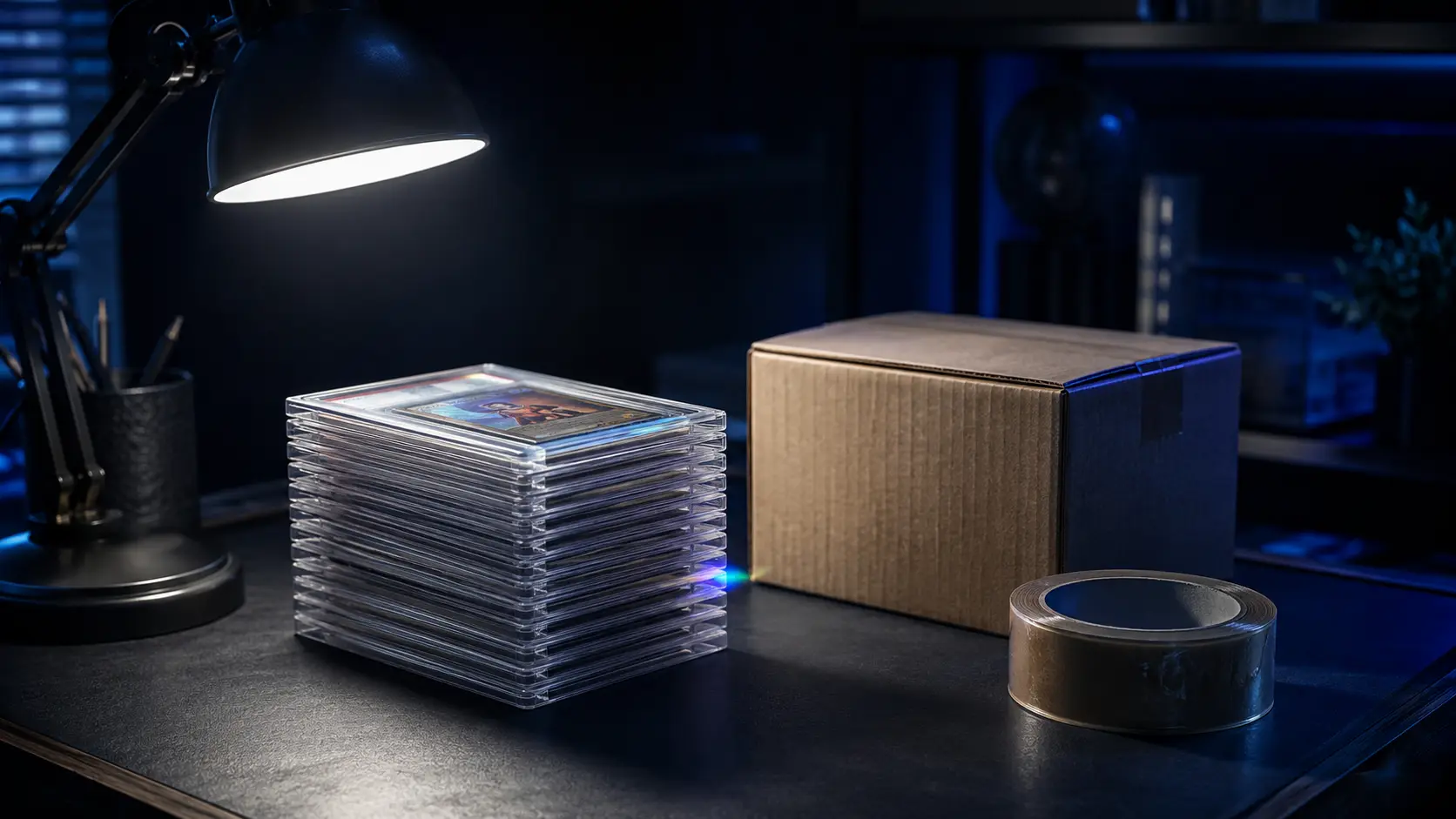
PSA Grading for Canadian Collectors
By Nathan Wiebe, CPA — collector, and a buyer and seller of cards. Published July 11, 2026.
Canadians grading with PSA have three routes: submit directly online and ship to PSA yourself, drop cards at a local shop that handles the submission for you, or join a group submission that splits shipping and customs cost across several collectors. PSA also runs a Mississauga, Ontario receiving centre for in-person drop-off, which skips mailing cards across the border entirely.
A graded card is one that's been examined by a third-party company, checked for corners, centering, edges, and surface, then sealed in a hard plastic slab with a number on the label. PSA, short for Professional Sports Authenticator, is the name most collectors know best, and a strong PSA grade can genuinely change what a card is worth to a buyer. Submitting from Canada works the same way in principle as submitting from anywhere else — you're still sending PSA your cards and getting them back in slabs — but the border adds a few real wrinkles. This guide covers what grading actually is, why Canadians run into extra friction, and the three routes collectors here actually use to get cards graded.
What Grading Actually Means
When PSA grades a card, a grader looks it over under controlled lighting and assigns a number from 1 to 10 based on how close to perfect the card is: centering, corner sharpness, edge wear, and surface condition all factor in. The card goes into a tamper-evident holder with the grade printed on the label, along with a certification number anyone can look up. That certainty is what buyers are paying for — an ungraded card — a "raw" card, in collector speak — has whatever condition buyer and seller agree it has, but a PSA 9 is a PSA 9 no matter who's holding it. Not every card is worth grading, since submission and shipping costs only make sense once a card's raw value clears a certain bar, but for the right card, grading can unlock value a raw copy simply can't reach.
Why Grading From Canada Takes Extra Planning
PSA's grading operations are based in the United States, so every Canadian submission crosses the border twice — once on the way down, once on the way back. That creates a few things collectors submitting from inside the U.S. don't have to think about nearly as much:
- Customs paperwork needs to be filled out honestly and clearly, and cross-border parcels can occasionally get held for review.
- PSA bills its fees in U.S. dollars, so the exchange rate is part of your real cost, not just the sticker price.
- A box of cards worth submitting is worth insuring, and cross-border shipping with tracking and insurance costs more than a domestic parcel does.
- Both the outbound and return legs simply take longer than a domestic shipment would, on top of PSA's own turnaround time once your cards arrive.
None of this makes grading from Canada impractical — plenty of Canadian collectors do it regularly — it just means the planning starts before you print a shipping label.
Route 1 — Submit Directly to PSA Yourself
The most straightforward route is creating a PSA account, building your submission online, and shipping your cards to PSA yourself. You're in full control of packing, insurance, and the declared value on your customs form, and you deal with PSA's customer service directly if anything comes up. The tradeoff is that you're also the one handling cross-border shipping and customs paperwork, and you're paying full retail on shipping and insurance instead of sharing it with anyone else. This route tends to suit collectors who submit often enough to have a system down, or who have a small number of higher-value cards where direct control over every step matters.
Route 2 — Drop Off at a Local Shop
A number of Canadian card shops offer grading services of their own: they'll take your cards in person, handle the submission and cross-border shipping on your behalf, and hand you your slabs when they arrive. Because the shop is submitting regularly, it's usually current on PSA's submission process and any customs quirks, which takes that entire piece off your plate. In our directory, shops that list grading services among what they offer include 306 Sports Cards in Saskatoon, SK, 401 Games Vaughan in Vaughan, ON, and 401 Games in Toronto, ON. If you're near one, it's worth a call to ask about their current process and whatever they charge on top of PSA's own fees.
Route 3 — Group Submissions
Some shops and local collector communities organize group submissions: a batch of cards from several collectors shipped to PSA together under one combined submission. Because shipping, insurance, and customs paperwork are shared across the whole group instead of paid in full by one person, group submissions can meaningfully cut the per-card cost of grading, especially for cards that wouldn't be worth submitting solo. If that interests you, ask your local shop whether they run them, or watch for community-organized submission windows — they're usually announced with a deadline for dropping cards off before the batch ships.
What Grading Actually Costs
We're not going to quote you a number here, and that's on purpose. PSA's pricing depends on the service tier you choose, since faster turnaround costs more, the declared value of your card, and membership status, and all of it changes over time. Rather than print a price that's wrong six months from now, go straight to PSA's official pricing page for current tiers and turnaround estimates before you submit. If you're going through a local shop, ask them directly what they charge on top of PSA's own fee for handling your submission.
Getting Your Cards Ready
However you submit, cards travel best in a soft penny sleeve inside a semi-rigid holder — never loose in a hard plastic toploader that leaves room to shift and scuff a corner in transit, and never with tape touching the card itself. Double-check PSA's current submission form for exactly what they need declared, and photograph your cards before they leave your hands, just in case you ever need to reference their condition later.
Which Route Fits You
If you submit often, want full control, and don't mind handling cross-border shipping yourself, submitting direct works well. If you'd rather hand the logistics to someone who does this regularly, a local shop that offers grading services does that job for you. And if you've got a stack of lower-value cards that wouldn't be worth grading solo, a group submission is worth asking about. Whichever route you pick, the fundamentals don't change: check PSA's current pricing before you commit, pack your cards properly, and give the process the time it actually takes.
Submitting in person instead of by mail? PSA opened a Canadian receiving centre in Mississauga — see our guide to the drop-off process for the address, hours, and what to bring. And if PSA isn't the only grader you're weighing, our comparison of PSA, SGC, CGC, and Beckett covers cost and turnaround across all four, plus the Canadian graders that skip the border entirely.
FAQ
- What are the three ways Canadians submit cards to PSA?
- Submitting directly online and shipping to PSA yourself, dropping cards off at a local shop that handles the submission on your behalf, and joining a group submission that shares shipping and customs cost across several collectors.
- Can I drop cards off at PSA in person from Canada?
- Yes — PSA operates a Canadian receiving centre in Mississauga, Ontario, where collectors build their submission online first and then bring the cards in person, skipping the mailed cross-border shipment entirely. Address, hours, and how drop-off works
- How much does PSA grading cost from Canada?
- We're not printing a number here, since PSA's fees depend on the service tier, the card's declared value, and membership status, and all of it changes over time. Check PSA's own pricing page for the current tiers before you submit. PSA's official pricing page
- Do any Canadian shops handle PSA submissions for you?
- Yes — 44 shops in our directory list grading services among what they offer, meaning they'll typically handle a PSA submission on your behalf.
Know a shop that offers grading services we're missing? Suggest it.